Peoria sits at an elevation of roughly 1,140 feet within the Sonoran Desert, a landscape shaped by episodic sheet flooding and deep alluvial fan deposits. The city’s rapid expansion northward into the foothills of the Hieroglyphic Mountains frequently encounters cemented gravels and interbedded silty clays that challenge standard penetration testing. When a project involves deep excavations or heavily loaded mat foundations, simple bearing capacity assumptions are no longer sufficient. Our laboratory evaluates undisturbed Shelby tube samples under multi-stage confining pressures, generating Mohr-Coulomb failure envelopes that define the true drained and undrained shear strength of the formation. For structures exceeding three stories, this data becomes essential to satisfy the lateral earth pressure provisions of the IBC.
Effective stress parameters from a CU triaxial test can reduce required retaining wall sections by 15% compared to conservative total stress assumptions.
Methodology applied in Peoria Arizona
Typical technical challenges in Peoria Arizona
A ten-story medical office building near the Loop 101 freeway encountered a layer of silty sand with visible mica flakes at a depth of 25 feet. Standard penetration blow counts were misleadingly high due to the apparent cohesion from partial saturation above the static water table. Extruding the Shelby tubes in the lab revealed that the soil structure collapsed upon saturation. A series of three consolidated-undrained triaxial tests on the critical stratum showed a dramatic loss of effective friction angle under pore pressure buildup, dropping below the threshold required for the original spread footing design. The geotechnical engineer of record was forced to change the foundation system to a deep piles solution to bypass the sensitive layer. Ignoring the stress-strain behavior of unsaturated collapsible soils in Peoria’s northern benchlands can lead to total differential settlement failures during the first heavy monsoon season.
Our services
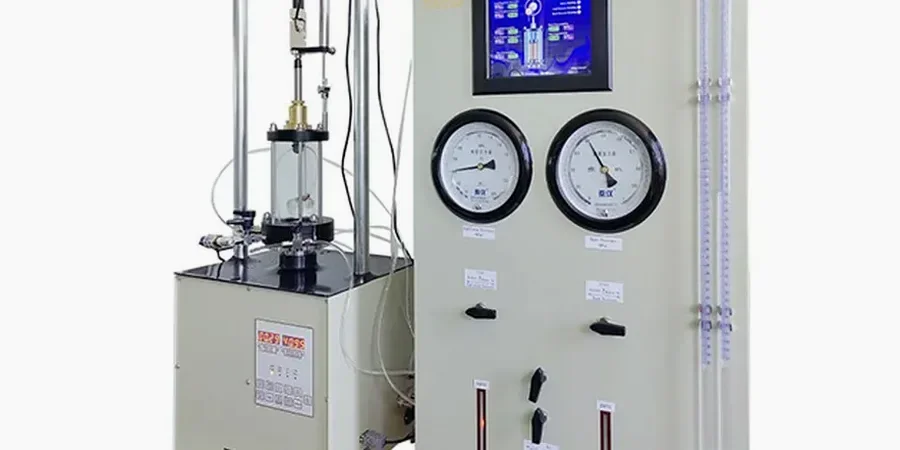
Our Peoria laboratory provides a full suite of specialized triaxial configurations to replicate complex field stress paths. We handle everything from sample trimming to final engineering report preparation, ensuring the data integrates seamlessly with your analysis software.
Consolidated-Undrained (CU) with Pore Pressure
The definitive test for determining effective stress shear strength parameters (c' and φ') in fine-grained soils. We apply back pressure saturation to achieve a Skempton B-value exceeding 0.95, then consolidate and shear multiple specimens to define the failure envelope for long-term slope stability and retaining wall design in Peoria’s colluvial deposits.
Unconsolidated-Undrained (UU) Triaxial
A rapid assessment of undrained shear strength (s_u) for cohesive soils under fast loading conditions. This method is frequently used for end-of-construction analysis of shallow footings on the saturated clays found along the Agua Fria River floodplain, where immediate bearing capacity governs the design.
Top questions
What is the typical cost of a triaxial test program in Peoria?
A standard series of three CU triaxial tests on a single soil stratum typically ranges from US$2,060 to US$2,540, depending on the required confining pressures and whether you need a UU quick check beforehand.
What is the standard turnaround time for a CU triaxial test?
A complete consolidated-undrained test series with pore pressure measurement usually requires 10 to 14 business days. The saturation phase alone can take 48–72 hours for stiff, low-permeability clays common in Peoria’s desert varnish soils.
Can you perform triaxial tests on coarse granular soils?
We can test granular materials using 4-inch diameter remolded specimens compacted to field density. While undisturbed sampling of clean gravels is difficult, reconstituted specimens offer reliable effective friction angles (φ') for the cemented cobble mixes found in the Sun City West area.
How does the triaxial test differ from a direct shear test?
The triaxial test controls the drainage and measures pore pressure during shear, which is impossible in a direct shear box. For the saturated, low-plasticity silts encountered near Lake Pleasant, the triaxial apparatus provides the only reliable method to separate drained and undrained behavior under realistic confining stresses.