Peoria’s rapid expansion northward from the Agua Fria River into the Hieroglyphic Mountains foothills has placed new subdivisions directly over alluvial fans and young basin-fill deposits. Much of this ground consists of loose, moisture-sensitive sands that can densify suddenly under load or during a seismic event. Vibrocompaction design offers a direct method to treat these weak zones before foundations go in. The process uses depth vibrators to rearrange granular particles into a tighter state, increasing relative density without bringing in outside fill. For sites near Lake Pleasant Parkway where groundwater can be deep, the dry bottom-feed technique often works best. Further south along the Beardsley corridor, higher water tables favor wet top-feed methods. The engineering team analyzes grain-size curves from grain-size testing and SPT blow counts from spt-drilling to build a treatment grid that matches the subsurface profile. With over 190,000 residents and growing, Peoria demands ground improvement strategies that perform reliably across its varied desert terrain.
A vibrocompaction grid designed for Peoria's alluvial sands typically achieves a relative density of 75 percent or higher, transforming collapsible ground into a competent bearing stratum.
Methodology applied in Peoria Arizona
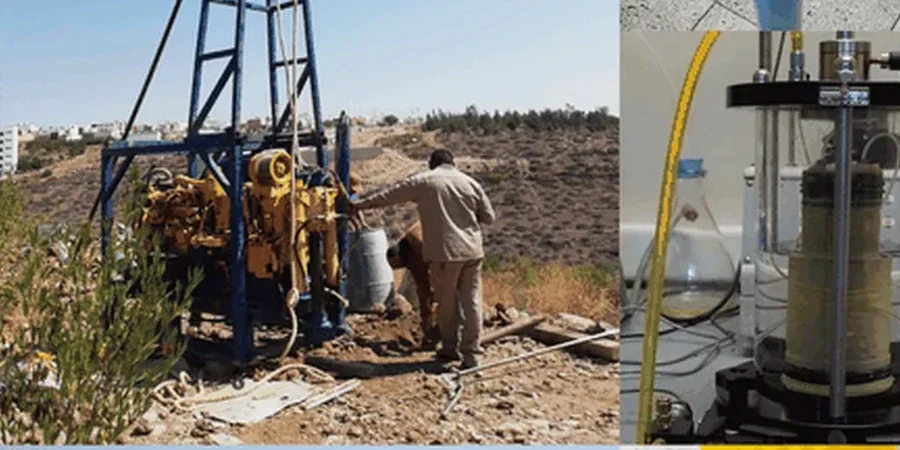
Typical technical challenges in Peoria Arizona
The City of Peoria adopts the IBC with local amendments, which reference ASCE 7 for seismic site classification. This framework makes vibrocompaction design particularly important here because loose Holocene alluvium can default to Site Class E or F if not improved. A Site Class D or better is often required by the structural engineer to keep foundation sizes reasonable and avoid costly deep foundations. The highest risk occurs when a designer assumes uniform densification but the subsurface contains discontinuous hard layers that shield energy from reaching deeper loose zones. Without careful quality control, untreated lenses can remain at depth and cause differential settlement years after the building is occupied. The design must also account for the arid climate: near-surface soils in Peoria frequently exhibit suction-induced apparent cohesion that disappears when irrigation or monsoon rains infiltrate, potentially triggering hydrocompaction in silty sands that were not properly densified below the moisture-affected zone.
Our services
Our vibrocompaction design activities in Peoria cover the full project cycle: from initial site characterization and treatment specification to field verification and as-built documentation. The approach adapts to the specific development pattern, whether it is a single commercial pad near Bell Road or a multi-phase residential subdivision in the northern growth corridor.
Treatment Design and Grid Layout
We determine probe spacing, depth intervals, and vibration parameters based on grain-size distribution, SPT data, and target performance criteria. The design package includes a detailed grid plan, sequence of passes, and acceptance testing protocol.
Post-Treatment Verification
Using pre- and post-compaction CPT soundings, we quantify the increase in tip resistance and sleeve friction at each depth. The verification report compares achieved relative density against the design target and identifies any zones requiring re-treatment.
Top questions
What is the typical cost range for vibrocompaction design in Peoria?
The design phase generally ranges from US$1,670 to US$5,420, depending on the treated area, number of probe points, and required verification testing. Larger subdivisions with multiple soil zones will fall toward the upper end due to the extra analysis and reporting involved.
How long does the vibrocompaction design process take?
A typical design package for a single-family lot or small commercial site can be completed in 7 to 10 business days after receiving the geotechnical investigation report. For larger subdivision projects covering 20 acres or more, the design and coordination phase may extend to three weeks.
Can vibrocompaction eliminate the need for deep foundations in Peoria?
In many cases, yes. When loose sands and silty sands are densified to a relative density of 75 percent or more, the improved ground can support shallow spread footings instead of driven piles or drilled shafts. The final decision depends on structural loads and the post-treatment CPT results.
Is vibrocompaction effective in the caliche layers found around Peoria?
Caliche and cemented soils do not densify well under vibration alone. The design must identify these hard layers from SPT refusal zones and plan either pre-drilling to break through the crust or a hybrid approach that combines vibrocompaction in the loose sands with stiffened footings where caliche remains.