Contractors in Peoria Arizona often underestimate how fast collapsible soils can ruin a slab-on-grade floor. The city sits on interbedded alluvial fan deposits from the Agua Fria River drainage system. These young sediments include silty sands and low-plasticity clays that densify poorly under conventional compaction. Excavate and replace works for shallow depths. Below ten feet the cost explodes and the water table in some northwest Peoria neighborhoods complicates dewatering. Stone column design bypasses these limits. We install compacted gravel columns through the soft layer down to competent bearing strata, creating a composite ground mass with higher stiffness and drainage capacity. The technique reduces total settlement and speeds consolidation time, which keeps your project schedule intact without over-excavation claims. For deeper liquefaction-prone sand lenses we combine the approach with CPT testing to calibrate spacing and diameter before the rig mobilizes.
A well-designed stone column grid turns loose basin fill into a stiff composite mass, cutting settlement risk by half in Peoria's variable alluvium.
Methodology applied in Peoria Arizona
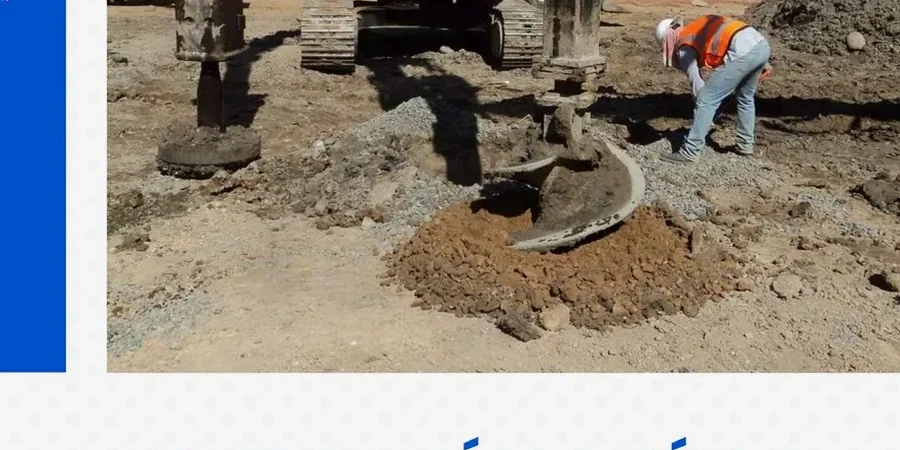
Typical technical challenges in Peoria Arizona
Peoria sits at roughly 1,100 feet elevation on the northern edge of the Salt River Valley, where the groundwater table fluctuates seasonally by several feet. That fluctuation triggers fine particle migration in silty lenses. A stone column design that ignores this can lose stiffness within two monsoon seasons. Undrained loading during installation generates excess pore pressure in saturated soft clay. If the column spacing is too tight, the pore pressure build-up causes ground heave instead of densification. We monitor pore pressure dissipation with piezometers during trial installations and adjust the installation sequence to let excess pressure bleed off before adjacent columns are built. Another local hazard is the presence of gypsiferous soils in the western reaches near the White Tank Mountain foothills. Gypsum dissolves slowly under sustained seepage, creating voids that compromise column bearing. Our field team runs sulfate content tests on samples from each boring before finalizing the aggregate specification and cementitious additive strategy.
Our services
Our stone column work in Peoria Arizona covers design, field testing, and construction-phase verification. Each project starts with a targeted subsurface investigation to map the soft zones.
Stone Column Design Package
Full design report with column diameter, grid spacing, depth, area replacement ratio, settlement estimates, and installation sequence tailored to the site's stratigraphy and structural loads.
Trial Installation and Load Testing
Modulus load tests on single columns and column groups, plus cross-hole shear wave measurements to confirm stiffness improvement before production starts.
Construction-Phase QA/QC Monitoring
Daily field logging, SPT verification borings between columns, and pore pressure monitoring during vibro-replacement to ensure compliance with design specifications.
Top questions
What type of stone do you use for columns in Peoria projects?
We specify clean crushed angular stone with a friction angle above 40 degrees. The gradation follows ASTM D2487 limits, typically a 3/4-inch to 2-inch size range with less than 5 percent passing the #200 sieve. Rounded gravel is not accepted because it lacks the interlock needed for load transfer. In areas with high sulfate soils west of the White Tanks, we test the aggregate for chemical compatibility before approval.
How much do stone column design and testing services cost for a typical Peoria lot?
For a standard residential or light commercial parcel in Peoria Arizona, the design package plus trial installation and load testing typically ranges from US$1,390 to US$5,910. The final cost depends on the number of columns in the test program, the depth to competent bearing, and whether pre-drilling through caliche layers is required. We offer a fixed-fee proposal after reviewing the geotechnical report and site plan.
How do you verify the columns actually improved the ground?
We run modulus load tests on isolated columns using a reaction frame and hydraulic jack, measuring settlement under design load. Between columns we drill SPT verification borings and compare blow counts to pre-treatment values. In critical areas we also perform cross-hole shear wave velocity tests to confirm the stiffness increase matches the design modulus. All results go into a stamped QC report for the city's permitting file.