The Arizona Department of Transportation (ADOT) and most Maricopa County municipalities require a soaked laboratory CBR value to validate the structural design of flexible pavements. In Peoria, where summer monsoons can dump over an inch of rain in an afternoon on a normally arid profile, the difference between a dry CBR and a soaked CBR can be dramatic. We see it every season: a subgrade that looks perfectly competent in October can soften to less than half its dry strength after saturation. The grain-size analysis provides the first clue, but the laboratory CBR test under controlled moisture and density conditions quantifies the actual bearing capacity the pavement structure will knowledge during the worst-case scenario. Our lab compacts samples at Standard or Modified Proctor energy per ASTM D698 or D1557, then soaks them for 96 hours to simulate long-term saturation before applying the penetration piston at 0.05 inches per minute.
A soaked CBR of 3 versus 8 changes the required aggregate base thickness by several inches — and the project cost by thousands of dollars per lane-mile.
Methodology applied in Peoria Arizona
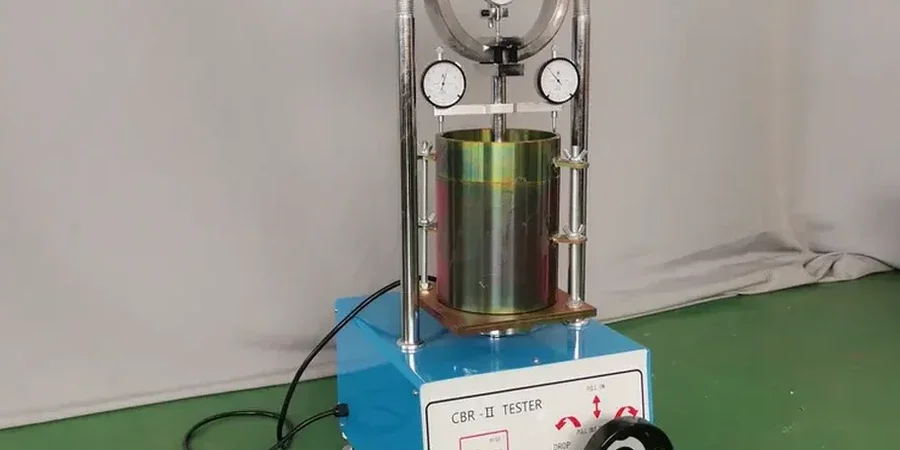
Field demonstration
Typical technical challenges in Peoria Arizona
The valley floor around the Loop 303 corridor and northern Peoria contains significant pockets of expansive clay derived from weathered basalt and sedimentary formations. These clays can exhibit PI values above 30, and their soaked CBR often falls below 5, which is the threshold where ADOT pavement design tables begin requiring substantial aggregate base reinforcement. Ignoring the soaked condition and designing solely on a dry CBR — something we have seen in older subdivisions built before current standards — leads to premature fatigue cracking and rutting within the first five to seven years of service. The IBC and ASCE 7 load combinations do not directly address subgrade moisture sensitivity, so the laboratory CBR test remains the primary empirical tool for quantifying this risk. For streets serving school bus routes or emergency access in master-planned communities like Vistancia, the city of Peoria engineering standards explicitly require a minimum soaked CBR of 6 or higher, verified by lab testing.
Our services
Each laboratory CBR test we run in Peoria is part of a broader pavement evaluation workflow. The three activities below are the ones our local contractors and civil engineers request most frequently.
Laboratory CBR test (soaked, 3-point)
Full test at three compaction levels to generate the CBR-density curve, required by ADOT for major arterial and collector street design in Peoria subdivisions.
Single-point CBR verification
Compact one specimen at the specified field density, soak for 96 hours, and report the soaked CBR. Common for small commercial pad sites and private access roads.
CBR with swell measurement
Includes continuous swell monitoring during the soak period using a dial gauge, critical for evaluating expansive subgrades in the northern Peoria corridor.
Top questions
What does a laboratory CBR test cost in the Peoria area?
For a single-point soaked CBR test on a remolded sample, you can expect a laboratory fee in the range of US$120 to US$200. A three-point CBR curve for ADOT submittals typically falls toward the upper end due to the additional compaction and testing effort.
How long does the lab CBR test take from sample delivery to report?
Plan on five to seven working days. The compaction and setup take one day, the standard soak is 96 hours, and the penetration test plus report preparation requires an additional day. We can accommodate a 72-hour expedited turnaround for critical projects when arranged in advance.
Can we use a field DCP instead of a laboratory CBR for Peoria city approval?
The Dynamic Cone Penetrometer is useful for site variability screening, but the city of Peoria and ADOT still require a laboratory soaked CBR value for the formal pavement design report. The lab test controls moisture and density in a way that field testing cannot replicate, and it provides the basis for the structural number calculation.
What Proctor energy should we specify for a residential subdivision street?
Most Peoria residential streets are designed using Standard Proctor (ASTM D698) because the compaction equipment and specifications in the field align with that energy level. Modified Proctor (ASTM D1557) is occasionally requested for industrial lots or heavy truck traffic areas, but it can produce an unrealistically high CBR if the field compaction crew cannot achieve that density.