The most costly mistake we see in Peoria is treating base isolation like a standard foundation package. This city sits on basin sediments with variable stiffness. A generic isolator spec fails fast. You get excessive drift or the isolation period lands right on the soil's fundamental period. That doubles the acceleration instead of cutting it. We start every project by mapping the site-specific response spectrum. Not the default ASCE 7 curve. The real one. That data drives the isolator selection. Before locking in the structural grid, many teams run a deep CPT test to catch loose sand lenses that skew the ground motion. The basin geometry under Peoria amplifies long-period waves. If your building period hits that amplification zone, you designed an expensive resonator. We prevent that.
Base isolation in Peoria is not about the bearing. It is about the ground motion prediction that sizes the bearing.
Methodology applied in Peoria Arizona
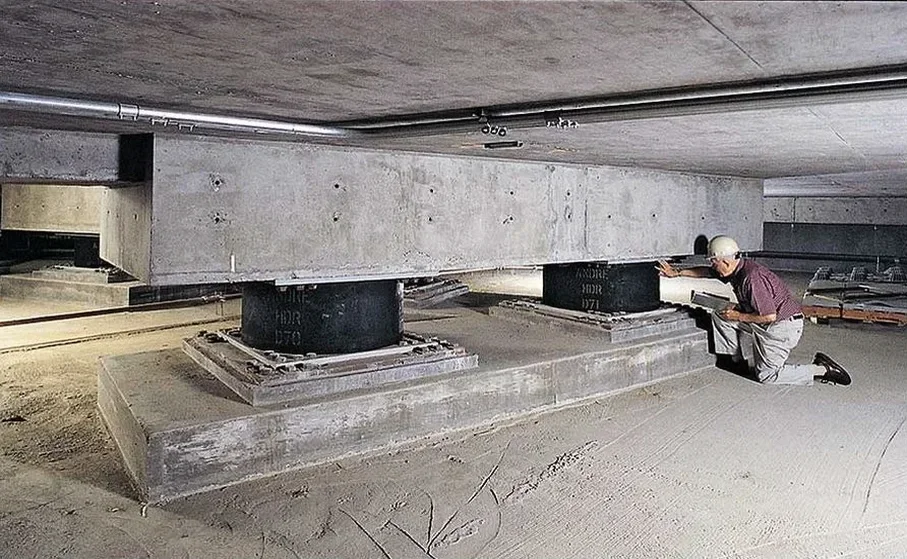
Typical technical challenges in Peoria Arizona
The basin alluvium under Peoria is not uniform. We encounter interbedded gravel, sand, and stiff clay from the ancestral Agua Fria deposits. Abrupt stiffness contrasts between these layers generate secondary wave reflections. A site class D profile can produce surface spectra that deviate significantly from the code default. If the isolation system is designed using the smoothed ASCE 7 spectrum without site response analysis, the predicted displacements can be off by 30 percent or more. That gap translates directly into moat size, joint detailing, and utility connections. Fixing a misdesigned moat after the superstructure is up costs more than the entire isolation study. The other risk is torsion. Eccentricity between the center of mass and the center of rigidity of the isolation plane amplifies corner displacements. We catch that early with a 3D model tied to the subsurface layering.
Our services
Our scope covers the entire isolation design cycle, from the geophysical baseline to the final bearing test protocol.
Site-Specific Ground Motion Analysis
We run 1D wave propagation and, where basin-edge effects dominate, 2D site response models. The output is a site-specific spectrum and acceleration time histories matched to the Peoria subsurface profile. This replaces the generic ASCE 7 spectrum and feeds the structural engineer's isolation model.
Isolator Specification and Peer Review
We prepare performance criteria for elastomeric bearings (LRB, HDR) and friction pendulum systems. The package includes displacement capacity, yield force limits, restoring force requirements, and prototype test acceptance criteria per ASCE 7 Chapter 17.
Top questions
At what building height or type does base isolation become viable in Peoria?
There is no fixed height threshold. We see isolation applied from two-story essential facilities (fire stations, data centers) to mid-rise commercial buildings. The decision hinges on the performance objective. If the owner requires immediate occupancy after the design earthquake, isolation is the most direct path. The cost-benefit becomes clear when you compare the isolation premium against the business interruption loss avoided over a 50-year return period.
What does a base isolation design package cost for a Peoria project?
For a typical commercial or institutional building in Peoria, the geotechnical and seismic isolation design package ranges from US$4,440 to US$7,620, depending on the number of borings, the depth of the velocity profile, and whether nonlinear time-history ground motion matching is required. A more complex basin-edge site with 2D modeling will be at the upper end of that range.
How long does the site-specific ground motion study take before the structural designer can start?
Allow four to five weeks from the completion of the field work. The critical path is the shear wave velocity profile. We log the borehole with a downhole or suspension PS logger. Once we have the VS30 and the deeper velocity structure, the 1D site response analysis takes about two weeks. Peer review by a second firm adds another week if required by the building official.