Peoria’s subdivision boom pushes deep into ancient alluvial terraces. The biggest headache we see on site isn’t the heat. It’s the hardpan. A soil mechanics study here has to deal with Stage IV caliche lenses that fool a standard backhoe bucket and expansive clay pockets that swell 30% between monsoon cycles. We run index tests under ASTM D2487 and D4318 before any footing gets sized. The focus is compressibility and sulfate exposure. When the site sits below the 100-year flood fringe of the New River, we combine the soil mechanics profile with a CPT test to map soft zones under the crust. That data feeds directly into the IBC Chapter 18 compliance package the City of Peoria requires for permit submittal.
Caliche isn't bedrock. Treating it as such without a lab swell test is the fastest way to crack a slab in Peoria.
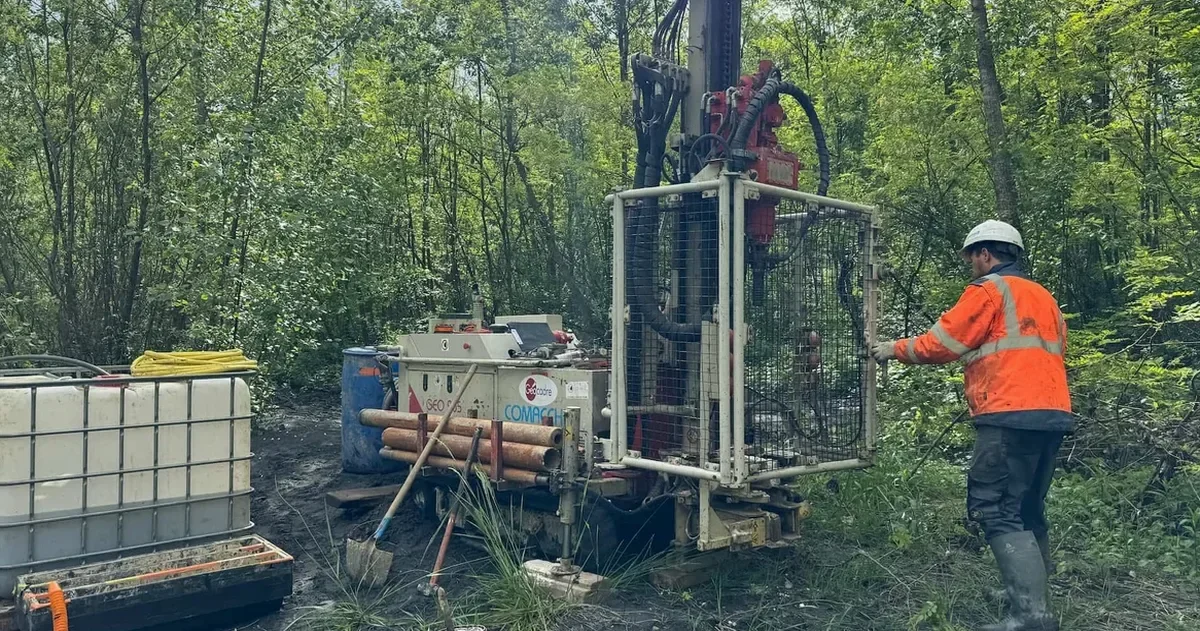
Methodology applied in Peoria Arizona
Typical technical challenges in Peoria Arizona
Peoria grew fast. In the 1990s, whole neighborhoods went up north of Bell Road on old agricultural land. Some of those plots had decades of flood irrigation soaking the subgrade. Collapse potential on relict farm soils remains a real liability. We’ve logged moisture contents above 22% at 6 feet in August. That’s not natural. A soil mechanics study catches this through dry density comparison and collapse index testing. The risk isn’t uniform; it’s concentrated in pockets of the old citrus belt. Missing it means differential settlement that shows up as stair-step cracks in CMU walls within three years. The geotechnical report maps those zones and prescribes either overexcavation or moisture-conditioned recompaction before slab-on-grade construction.
Our services
We structure the soil mechanics scope around Peoria’s specific geohazards: heave, collapse, and hard excavation. Field crews mobilize a truck-mounted drill rig with hollow-stem augers or a CPT track depending on access. The lab runs classification, strength, and chemical tests in parallel. Turnaround is typically seven working days from final sample depth.
Foundation Design Parameters
Net allowable bearing capacity, modulus of subgrade reaction, and friction angle for spread footings. We include a slab-on-grade moisture vapor transmission analysis when the finish floor is epoxy or wood.
Expansive Soil Mitigation
Post-tensioned slab design inputs, moisture barrier recommendations, and prescriptive overexcavation depths based on suction profiles measured in the lab.
Corrosivity & Chemical Suite
pH, resistivity, soluble sulfate, and chloride content. Critical for selecting concrete mix design and protective coatings for buried utilities in Peoria’s sulfate-rich soils.
Construction Observation
Subgrade proof-rolling verification, fill placement testing, and rebar inspection during foundation construction. We sign off the IBC special inspection card.
Top questions
What does a soil mechanics study cost for a single-family lot in Peoria?
For a standard residential parcel under 0.5 acres, the investigation typically ranges from US$2,910 to US$5,560. The spread depends on drill depth — caliche refusal often stops augers short, but if we need to core through hardpan, mobilization costs increase. The fee covers the drill crew, lab index tests, and the stamped geotechnical report.
Does the City of Peoria require a soil report for a room addition?
Yes, if the addition exceeds 400 square feet or involves a new foundation system. The City reviews reports against IBC 2021 and the Maricopa Association of Governments standard details. We submit sealed calculations for bearing capacity and lateral resistance with the building permit package.
How do you sample hard caliche without washing out the fines?
We use a triple-tube core barrel with a carbide bit. Water flow is kept below 3 GPM to preserve the matrix. The core is waxed on site and transported to the lab for unconfined compression and point load testing. Standard split-spoon sampling in caliche leads to recovery ratios below 20%, which isn't representative.
What’s the turnaround for the final report?
Seven business days after field completion. Swell tests run five days minimum for the full ASTM D4546 curve. If the project is on a tight timeline, we can issue a preliminary bearing capacity letter within 48 hours so the structural engineer can proceed with foundation sizing.