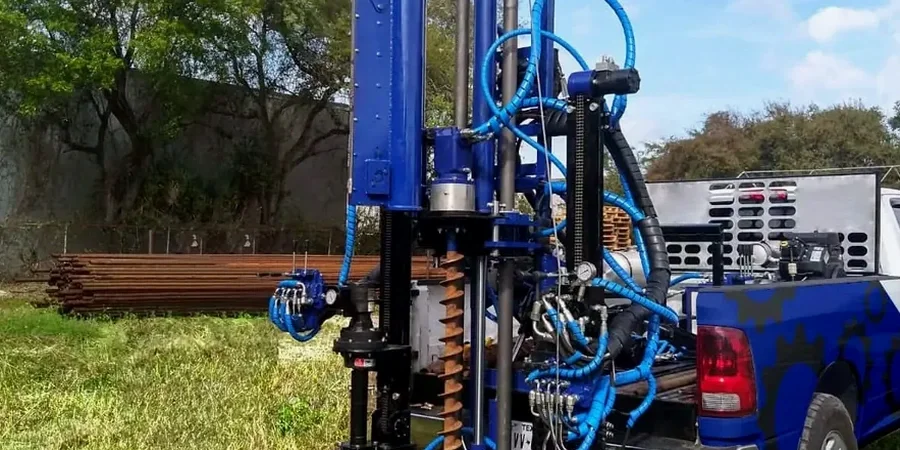
Peoria’s northward push into the Hieroglyphic Mountains foothills wasn’t just a real estate bet — it was a gamble on geology. As the city ballooned past 190,000 residents, developers hit everything from cemented caliche to loose alluvial fans draining toward the Agua Fria River. A proper SPT program here isn’t a box to check; it’s the difference between a foundation that settles evenly and one that cracks before the drywall goes up. We run the split spoon sampler to refusal, logging blow counts and recovering disturbed samples for classification, because the transition from basin fill to weathered granite happens fast along the Loop 303 corridor. For deeper soil characterization, we often pair SPT with CPT testing to cross-check cone resistance against N-values, especially where gravel-sized particles can skew the hammer energy.
In Peoria, an SPT refusal on caliche doesn’t mean stop — it means reclassify. That hardpan is your bearing layer, not an obstacle.
Methodology applied in Peoria Arizona
Typical technical challenges in Peoria Arizona
Look, we’ve seen too many Peoria jobs where the geotech report got skimmed and the SPT logs ignored. The most frequent headache is differential settlement across a single building footprint — one corner sits on dense caliche, the other on loose sandy fill from the 1980s grading boom. You won’t see it until the stucco starts cracking around year two. Another overlooked risk is liquefaction potential in the lower reaches near the Agua Fria floodplain: saturated fine sands at shallow depth, with N-values under 10, can lose strength during a moderate earthquake. The Arizona Geological Survey maps the west side as capable of producing a magnitude 6.5 event. Skipping SPT in those zones isn’t just a code violation under IBC Section 1803 — it’s a liability that no amount of post-tensioning can fix.
Our services
We structure SPT investigations in Peoria around the specific subsurface challenges of the Sonoran Desert, from the hard caliche benches of West Wing Mountain to the softer alluvial soils near the New River. Each program integrates lab testing to turn raw blow counts into design parameters.
Standard SPT Drilling Program
Rig-mounted SPT borings at 2.5 to 5-foot intervals, with disturbed sample recovery for laboratory grain size analysis and Atterberg limits testing in our ISO 17025-accredited soil lab.
Combined SPT & Shear Wave Velocity
Downhole seismic shear wave measurements taken at SPT boreholes to establish Vs profiles for IBC Site Class determination, particularly in Peoria’s deeper basin areas where site amplification factors can control seismic design.
Top questions
What does an SPT boring program in Peoria typically cost?
For a standard residential or light commercial investigation in Peoria, SPT drilling typically runs between US$560 and US$750 per boring, depending on depth and access. A full program with three borings to 20–30 feet, including lab classification of recovered samples and a signed geotechnical report, commonly falls in the US$2,200–US$3,500 range. Hard caliche layers that slow drilling can push the per-foot cost higher.
How many SPT borings does Peoria’s building department require for a single-family home?
Peoria follows the IBC and the city’s adopted amendments, which generally require a minimum of two borings for a single-family residence on a standard lot. If the site has known geologic variability — say, proximity to a mapped wash or a known caliche bench — the reviewing engineer may ask for a third boring to confirm bearing conditions across the footprint.
How do you handle SPT refusal on caliche layers common in Peoria?
When the split spoon hits a petrocalcic horizon and refusal occurs at less than 50 blows in six inches, we log the N-value as 'refusal' and note the depth. We then switch to rock coring if confirmation of thickness is needed, or treat that layer as the bearing stratum if it’s sufficiently thick. The key is verifying lateral continuity across the site — caliche can pinch out abruptly.