A typical slope stability job out here starts with the drilling rig arriving on a Peoria hillside—maybe up near the Lake Pleasant corridor or a new subdivision backing up to the Sonoran Preserve. The crew sets up the SPT hammer, and we start logging the subsurface while the driller watches for changes in penetration resistance. In the Phoenix metro’s northwest valley, Peoria’s geology shifts fast: you can hit cemented caliche at 3 feet, then find loose granular deposits or expansive clay layers another 10 feet down. Our lab team runs triaxial and direct shear tests on those samples, pairing field observations with Atterberg limits data to flag clay seams that lose strength when wet. For deeper profiling in fractured granite or buried paleochannels, we sometimes combine the SPT work with a CPT test to map continuous strength profiles without disturbing the cuttings. When the terrain is too steep for a truck-mounted rig, we set up portable equipment and supplement the drilling with test pits to visually log root penetration and jointing in the rock face.
A Peoria slope that looks stable after a decade of drought can mobilize in a single monsoon season if the toe isn’t keyed into material below the weathering profile.
Methodology applied in Peoria Arizona
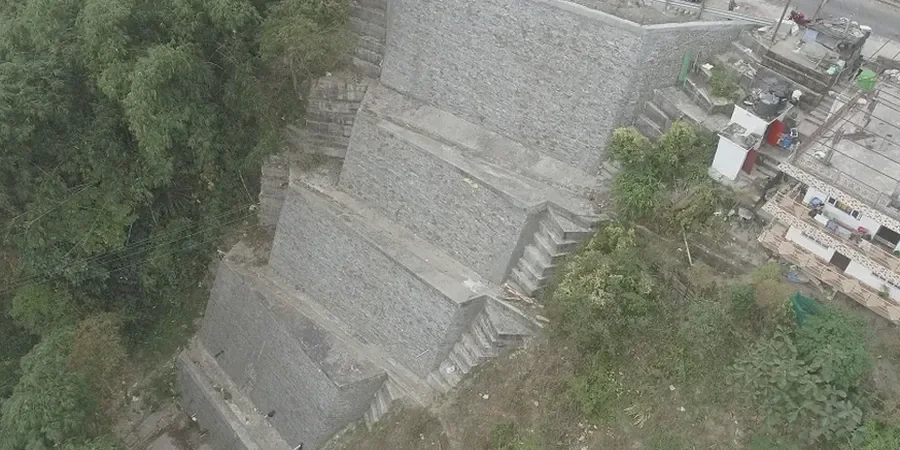
Typical technical challenges in Peoria Arizona
The mistake we see repeat in Peoria’s hillside subdivisions is contractors treating weathered granite like competent rock—they cut a near-vertical face assuming it’ll hold, then the first heavy August storm triggers a wedge failure that takes out the drainage swale and undercuts the lot above. What gets overlooked is the moisture-sensitive fabric of the decomposed material: the silt-sized particles that bond the grains during dry months dissolve or wash out when water infiltrates through desiccation cracks, and suddenly the cohesion component drops close to zero. Another pattern we catch during peer review is ignoring the influence of the Lake Pleasant regional groundwater mound—water levels can rise seasonally in ways that don’t show up on a single site visit in June. When the failure involves a retaining structure, the repair path often leads to retaining walls with deeper drainage provisions, but the cost of retrofit is orders of magnitude higher than getting the slope analysis right before grading begins. Erosion at the toe is the trigger for most shallow failures we investigate, so surface water management has to be baked into the stability model from the start.
Our services
Our slope stability work in Peoria covers the full chain from subsurface investigation to design recommendations, all run through our AASHTO-accredited and ISO 17025-certified lab in the Phoenix metro area. We don’t outsource the testing, so the turnaround from field to report is tighter than what most consultants can offer.
Static and pseudo-static slope modeling
Limit equilibrium analyses using Spencer and Morgenstern-Price methods, incorporating site-specific shear strengths from lab testing and ASCE 7-22 seismic coefficients for the Peoria area.
Field investigation and instrumentation
SPT drilling, test pits, and CPT soundings on hillside lots, plus inclinometer and piezometer installation where seasonal groundwater monitoring is required by the city’s grading permit conditions.
Remedial design and peer review
Stability re-evaluations for existing slopes showing distress, with repair recommendations ranging from regrading and drainage improvements to anchored shotcrete facing where right-of-way constraints limit the footprint.
Top questions
How much does a slope stability analysis cost for a Peoria hillside lot?
For a single-family residential lot in Peoria with a planned cut slope, the analysis typically runs between US$1,350 and US$4,330, depending on the number of borings, the depth of the investigation, and whether we need to install piezometers for seasonal groundwater monitoring. The spread covers a straightforward static analysis on one cross-section at the low end, up to a multi-section model with pseudo-seismic loading and lab shear testing at the upper end.
Does Peoria require a slope stability report for a building permit?
Yes—the City of Peoria’s grading ordinance and the IBC require a geotechnical report addressing slope stability for any cut or fill slope over 15 feet in height, or for slopes steeper than 2H:1V. The report must include a site-specific factor of safety analysis, and the city’s plan review engineers will check that the recommendations align with the 2024 IBC and the Arizona Administrative Code.
What’s the biggest geotechnical challenge with Peoria slopes?
The combination of collapsible soils in the upper profile and the seasonal groundwater response to monsoon rainfall. A slope that has stood for years can fail rapidly when water infiltrates desiccation cracks and saturates the transition zone between residual soil and weathered bedrock. Our approach always includes a sensitivity analysis on pore pressure conditions, because the dry-season water table rarely tells the full story.
How long does the analysis take from investigation to final report?
With a standard two-boring investigation and direct shear testing on select samples, we typically deliver the draft report within three to four weeks from the field date. If the city requires inclinometer monitoring or a wet-season groundwater observation period, the schedule extends accordingly, but we coordinate the preliminary grading recommendations early so the civil design doesn’t stall.