The northwest Phoenix metro area sits on a complex basin-and-range transition where shallow caliche layers overlie deep alluvial deposits, and bedrock can vary from 15 to over 100 feet across a single site. Running a seismic survey here means dealing with dry desert soils that kill geophone coupling fast — we spike every receiver and use 8-lb sledge strikes on aluminum plates to push signal through that attenuating surface zone. Refraction tomography gives us continuous P-wave velocity cross-sections down to 30 or 40 meters, which tells the contractor exactly where caliche hardpan transitions to softer sediment. For deeper targets like buried fault scarps near the Agua Fria River, we switch to reflection profiling with tighter CDP spacing and longer spreads, pulling usable reflectors from 80-100 meters even in coarse gravel. Combining these with downhole CPT testing ties velocity to actual tip resistance for better ground models.
Velocity contrasts below 800 m/s in basin fill are the first signal of loose material — we flag those zones before excavation reaches them.
Methodology applied in Peoria Arizona
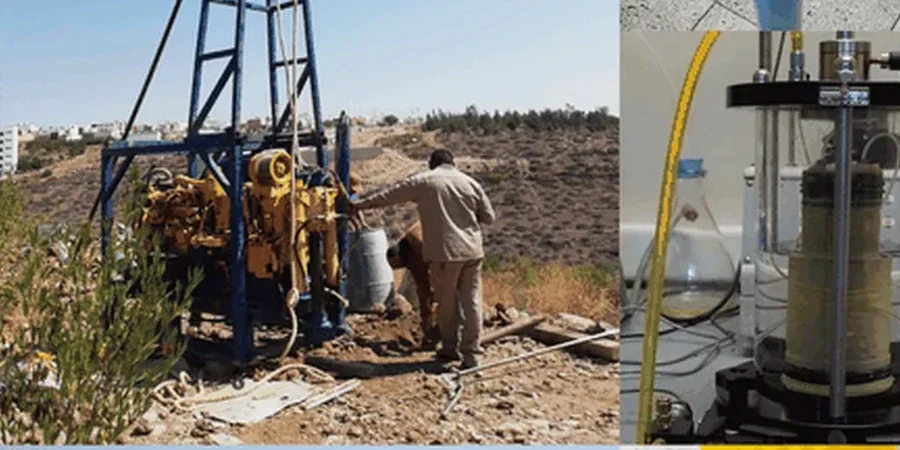
Typical technical challenges in Peoria Arizona
The Geode cable spread runs 115 meters tip-to-tip with takeouts every 2 meters — a snag on desert ironwood or careless foot traffic snaps a connector and we lose half the array. Field QC means stacking 5 to 8 hammer blows per shotpoint, watching the monitor for ambient noise from Lake Pleasant Parkway traffic a quarter-mile away. A common failure mode in Peoria is interpreting a velocity increase as bedrock when it is actually a continuous caliche hardpan at 1,200-1,500 m/s sitting above loose alluvium. We cross-check every profile against available borehole logs or push SPT drilling data to confirm the velocity-to-lithology tie. Skipping that step has led to excavators hitting unexpected boulders at 8 feet after a clean tomogram suggested uniform material — the velocity model was right, but the geological interpretation missed a cemented conglomerate lens that required blasting.
Our services
Our Peoria field crews deploy three complementary geophysical survey configurations, each matched to specific site conditions and investigation depth requirements across the West Valley. All data acquisition follows ASTM field standards with daily instrument calibration checks.
Refraction Microtremor (ReMi) & Vs Profiling
Passive-source shear-wave velocity profiling using ambient noise and 24-channel linear arrays. We extract dispersion curves and invert for 1D Vs profiles to 30 meters, delivering Vs30 values for IBC site classification without drilling. Effective in noisy urban corridors along Bell Road and Lake Pleasant Parkway.
Crosshole Seismic Tomography
Borehole-to-borehole P-wave and S-wave tomography between two or three cased drill holes spaced 3-5 meters apart. Achieves 0.3-meter vertical resolution for detecting thin soft layers, voids, or fracture zones. Used for critical infrastructure where surface methods lack resolution at depth.
Downhole Seismic Testing
Single-borehole method with a triaxial geophone clamped at 1-meter depth increments while triggering an S-wave source at surface. Produces interval velocity logs for direct correlation with SPT N-values and soil type. Ideal for liquefaction assessment in Peoria's sandier basin fill zones.
Top questions
What depth can seismic tomography reach in Peoria's desert soils?
Refraction tomography typically images to 30-40 meters depth with a 115-meter spread and sledgehammer source. For deeper targets we use a 200-kg accelerated weight drop that pushes first breaks to 60+ meters in dry alluvium. Reflection profiling can pull coherent reflectors from 80-100 meters when surface conditions allow good coupling. The limiting factor here is not equipment power but the high attenuation of dry, unconsolidated basin fill — signal dies fast above the water table, which sits below 100 meters in most of Peoria.
How do you distinguish caliche hardpan from true bedrock on a tomogram?
Caliche in the Phoenix basin typically shows P-wave velocities of 1,200-1,500 m/s — lower than true granitic or metamorphic bedrock at 2,500-4,000 m/s. But the velocity overlap with weathered bedrock is real. We look for velocity gradients: caliche usually shows a sharp cap at 1-1.5 meters thickness over slower material, while bedrock velocity increases steadily with depth. We always recommend at least one calibration boring or test pit to tie the geophysical contact to actual lithology, especially when rippability classifications affect excavation costs.
What does a seismic tomography survey cost for a typical Peoria lot?
For a standard residential or small commercial lot in Peoria, a combined refraction and MASW survey along two or three 115-meter lines typically runs between US$2,930 and US$5,870 depending on line length, number of spreads, and processing complexity. Sites with heavy vegetation, steep arroyo crossings, or requiring reflection profiling add mobilization and processing time. We offer fixed-price proposals after reviewing site plans and access conditions — no hidden day-rate charges.