Peoria sits on a complex mix of Quaternary alluvium and weathered bedrock, with caliche layers forming unpredictable hardpans just a few feet down. This changes everything for retaining wall design. Standard gravity equations fail when the backfill hits a rigid caliche lens at 4 feet and loose sand at 6. Our team drills before drawing. We correlate SPT blow counts from spt-drilling with lab shear strength to define the failure envelope the wall must resist. Lateral earth pressure isn't a textbook value here. It's a measured parameter, adjusted for the seasonal swelling of local clay and the site-specific peak ground acceleration defined in ASCE 7-22 Chapter 11 for Maricopa County.
A retaining wall in Peoria fails not because of one big load, but because of 20 years of monsoonal saturation cycles in expansive clay.
Methodology applied in Peoria Arizona
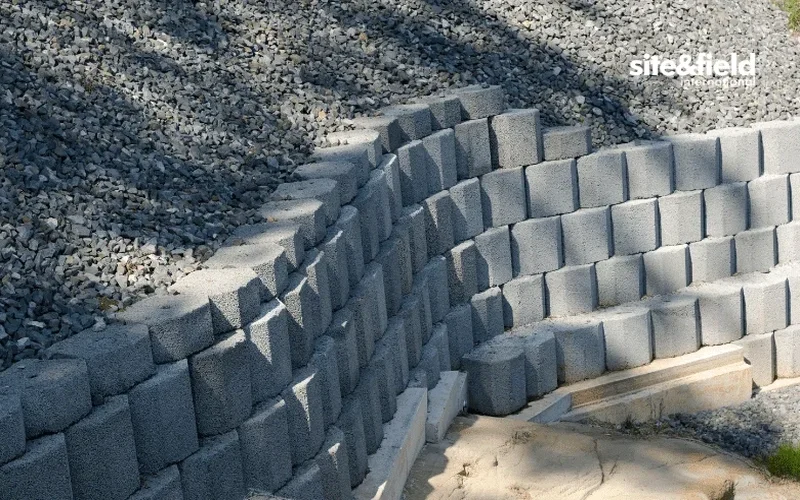
Typical technical challenges in Peoria Arizona
The drill rig tells the truth before a single yard of concrete is poured. For Peoria walls, we deploy a truck-mounted hollow-stem auger to punch through caliche crusts and recover Shelby tube samples. The risk is simple: differential settlement. If the wall footing rests partly on a caliche ledge and partly on softer alluvium, it will crack at the joint within three monsoon seasons. We've seen it. That's why we specify a uniform bearing stratum, verified by probe refusal depth across the entire wall alignment. Poor drainage is the second killer. We design the gravel drain and filter fabric to handle the flashy, high-intensity runoff typical of the Skunk Creek watershed, preventing hydrostatic buildup behind the stem.
Our services
We deliver a tight scope focused on the wall, not a generic report. Every calculation references a specific boring log from your Peoria site.
Geotechnical Investigation for Walls
Borings logged by a field engineer, with lab index testing to classify the soil and define the design shear strength profile at the wall line.
Structural Design Calculations
Overturning, sliding, and bearing capacity checks under static and seismic load combinations. We deliver reinforced concrete section drawings for the stem, toe, and heel.
Drainage and Backfill Specification
A drainage plan tailored to Peoria's monsoon intensity. We specify the gradation of the chimney drain, filter fabric, and weep hole spacing to prevent clogging.
Top questions
What does retaining wall design cost in Peoria, AZ?
For a typical residential or commercial wall in Peoria, the geotechnical investigation and structural design package ranges from US$1,020 to US$3,700. The final cost depends on wall height, length, and access for the drill rig.
Do I need a building permit for a retaining wall in Peoria?
Yes. The City of Peoria requires a permit for retaining walls over 4 feet in height, measured from the bottom of the footing to the top of the wall. Our stamped drawings meet the submittal requirements for the city's Development and Engineering Department.
How do you handle the caliche layers in the design?
We log the caliche during drilling and test its compressive strength. If it's massive and continuous, we can often bear the footing directly on it, reducing the wall size. If it's fractured or nodular, we treat it as a variable soil layer and design for the weaker material.
What seismic loads do you use for Peoria walls?
We pull the spectral accelerations Ss and S1 directly from the USGS Seismic Design Maps for the site coordinates. The seismic coefficient is calculated per ASCE 7-22 Chapter 11, factoring in Site Class determined from our shear wave velocity data.