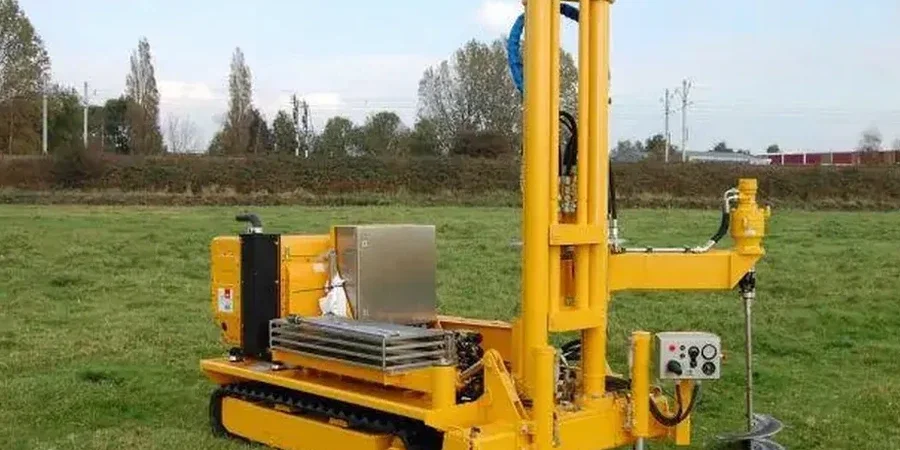
A 20-ton CPT truck sits level on a graded pad north of the Loop 303, hydraulic rams already engaging as the cone begins its first continuous push. In Peoria, where the subsurface shifts from wind‑laid silts to Stage III caliche within two vertical feet, the rig’s friction sleeve and pore‑pressure transducer record data every 2 cm — far finer resolution than a split‑spoon ever captures. The crew monitors tip resistance, sleeve friction, and dynamic pore pressure in real time, watching the friction ratio spike whenever the cone hits the thin, cemented lenses that blanket the Pleistocene basin floor. Because Peoria’s geology reflects both the ancestral Agua Fria floodplain and distal bajada fans, a single CPT sounding can map the transition from loose sandy clays into heavily indurated conglomerate without a single auger flight. Our laboratory verifies the electronic data against physical samples where needed, but the CPT’s strength lies in how little it disturbs the soil column while delivering a near‑continuous record of material behavior.
In Peoria’s basin soils, a cone that registers 200 tsf in caliche will read 15 tsf five feet higher — that vertical contrast makes CPT the only practical tool for mapping bearing stratigraphy without excavation.
Methodology applied in Peoria Arizona
Typical technical challenges in Peoria Arizona
A recurring mistake we see in Peoria is a contractor ordering only SPT borings and then designing shallow footings on an assumed uniform sand profile — only to encounter a caliche layer at 3 feet that the drill crew logged as ‘refusal’ without quantifying its actual strength. The resulting foundation ends up over‑excavated or, worse, partially bearing on cemented rock while the adjacent footing sits on loose silty sand, creating differential settlement that cracks slab‑on‑grade construction within the first two monsoon cycles. Another costly shortcut is skipping pore‑pressure dissipation tests when building detention basins or infiltration galleries over the fine‑grained alluvium common near the New River; without in‑situ consolidation parameters, drainage designs under‑estimate settlement time and over‑estimate infiltration capacity. A single CPT sounding with dissipation data at multiple depths eliminates both problems — it gives a continuous stiffness profile across the caliche boundary and provides cv values for each compressible layer.
Our services
Beyond the raw cone profile, we support Peoria projects with complementary field and lab work that turns CPT data into actionable geotechnical parameters:
Seismic CPT (SCPT)
A geophone module is added behind the cone to record shear‑wave velocity at 1‑meter intervals. The resulting Vs profile feeds site‑class determinations per ASCE 7‑22 Chapter 20 and enables rapid liquefaction screening in the Salt River basin.
CPT Pore‑Pressure Dissipation
After halting penetration at a cohesive layer, we monitor u2 decay until 50% consolidation is reached. This yields in‑situ coefficient of consolidation (cv) values far more representative than oedometer tests on remolded samples.
Soil Behavior Type Classification
Using the normalized SBTn chart (Robertson 2016), every 2‑cm data point is classified into one of nine behavior types — from gravelly sand to sensitive clay — giving a vertical stratigraphic log without subjective visual description.
CPT‑SPT Correlation for Local Soils
Where Peoria municipalities still require N‑values for bearing‑capacity tables, we develop site‑specific qc/N60 correlations by pairing a CPT sounding with a nearby SPT boring, accounting for the high‑carbonate fines that skew universal correlations.
Top questions
What depth can a CPT truck reach in Peoria’s caliche before refusal?
It depends entirely on the degree of carbonate cementation. In Stage I–II caliche the cone often pushes through with tip resistances around 40–60 MPa, reaching 30–40 ft before the rods buckle. Massive Stage III–IV caliche, common above the 303 corridor, can stop the cone at 8–12 ft. We always pre‑drill through suspected hardpan if depth targets require it.
Do you need a separate boring to classify soil when using CPT?
The reference range for this service in Peoria Arizona is US$190 - US$220. The final price depends on the project scope and volume.
How much does a CPT sounding cost on a typical Peoria residential lot?
For a single CPT sounding to 25–35 ft on an accessible lot within the Peoria city limits, the cost generally runs between US$190 and US$220 per push, which includes mobilization, the cone test, real‑time data acquisition, and a signed report with the SBTn log and dissipation data.
Can you run dissipation tests in sandy soils with fast drainage?
Dissipation tests work best in silts and clays where pore pressure decays slowly enough to record a reliable t50. In clean sands the excess pressure equalizes in seconds, so the data scatter is too high for meaningful cv values. We identify target depths from the real‑time u2 trace and only pause the push when the soil behavior type indicates sufficient fines content. More info.