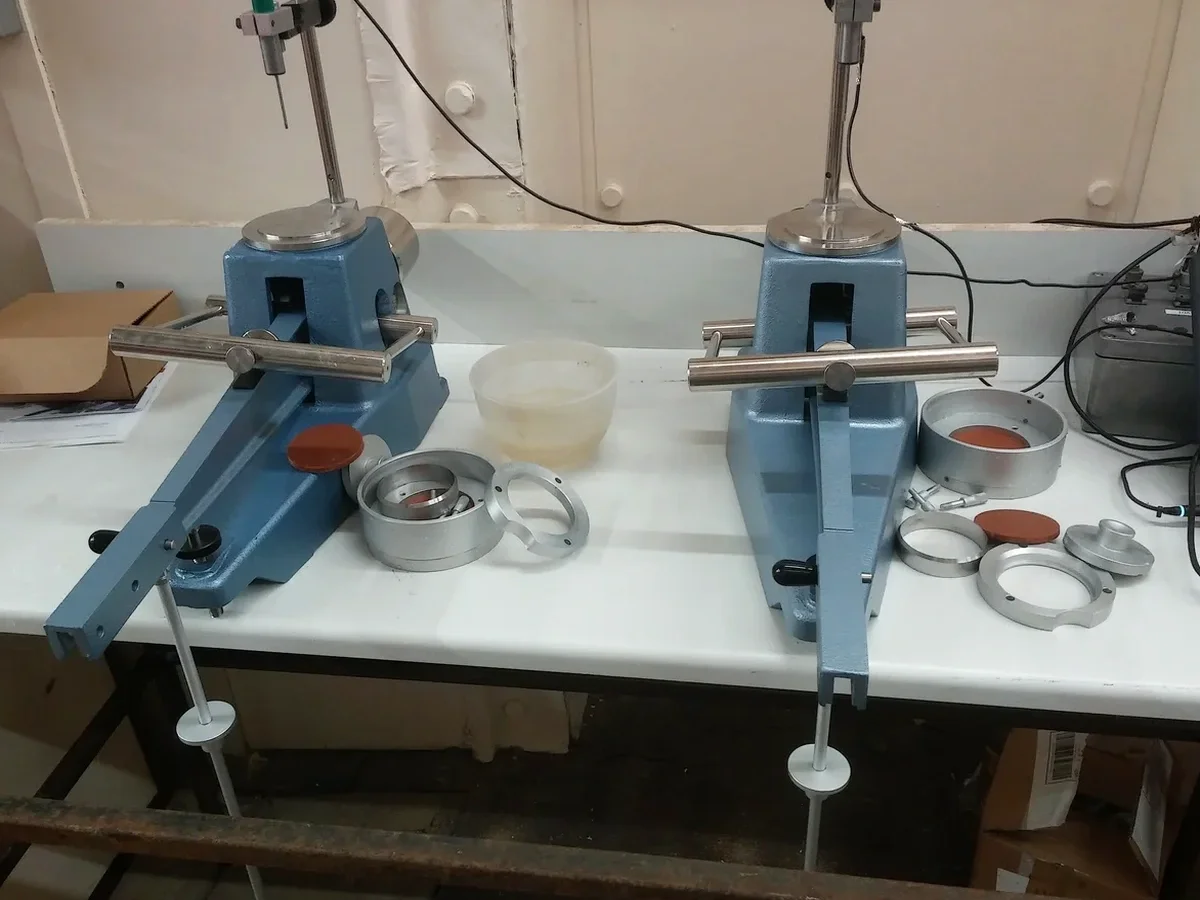
The lab setup for Atterberg limits in Peoria starts with a calibrated Casagrande cup and a glass plate that has seen thousands of soil threads rolled to 1/8-inch diameter. Our technicians work with oven-dried samples that pass the No. 40 sieve, mixing them with distilled water to just the right consistency. It is a manual process that demands a steady hand and a trained eye—the liquid limit device drops at exactly two blows per second, and the groove closure at 25 blows defines the boundary between liquid and plastic states. For local contractors, these numbers translate directly into foundation design decisions: a soil with a plasticity index above 25 will behave very differently during monsoon season than one below 15. We process samples from across the West Valley, from Vistancia to Lake Pleasant, knowing that the arid climate and sporadic rainfall create unique moisture cycling in near-surface clays.
A plasticity index above 30 in Peoria indicates high shrink-swell potential that must be addressed before foundation design.
Methodology applied in Peoria Arizona
Typical technical challenges in Peoria Arizona
Peoria, with a population exceeding 195,000 and an elevation around 1,140 feet, experiences annual precipitation of roughly 9 inches—but most of it arrives in concentrated monsoon bursts between July and September. This wet-dry cycling is exactly what activates the shrink-swell mechanism in high-plasticity clays. A soil with a liquid limit of 55 and a plasticity index of 35 may crack foundations and heave slabs when moisture content fluctuates, generating differential movements that exceed 2 inches in a single season. The IBC requires special inspection and engineered fill when expansive soils are present, and skipping the Atterberg determination means gambling on a soil classification that cannot be inferred from grain size alone. In the northern corridors of Peoria, where residential development continues at pace, we have measured plasticity indices above 40 in native soils that were subsequently treated with lime stabilization based on these same lab results.
Our services
Our Atterberg limits testing integrates with the full geotechnical investigation workflow. Each of these activities supports a specific stage of site characterization and foundation engineering in the Peoria area:
Full Atterberg Suite (LL, PL, PI)
Complete determination of liquid limit, plastic limit, and plasticity index on disturbed samples, with USCS classification and shrink-swell potential assessment for building permit submissions.
Shrinkage Limit Testing
Mercury displacement or wax immersion method to quantify the moisture content below which soil volume remains constant—critical for canal linings and retention basins in desert soils.
Soil Classification Package
Combined Atterberg limits, grain size distribution, and moisture content testing to assign a complete USCS group symbol and offer recommendations for fill suitability and compaction specifications.
Top questions
What does an Atterberg limits test cost in Peoria?
For a single sample tested for liquid limit, plastic limit, and plasticity index, the cost typically ranges from US$50 to US$90. The price varies depending on whether additional classification tests like grain size or moisture content are requested as part of a full geotechnical package.
How long does it take to get Atterberg limits results?
Standard turnaround is 3 to 5 business days from sample receipt. Expedited 24-hour processing is available when project schedules demand rapid classification for earthwork decisions. The liquid limit test itself requires careful moisture conditioning and multiple trial runs to achieve the 25-blow closure point within specification.
Why are Atterberg limits required for Peoria building permits?
Peoria enforces IBC requirements that mandate classification of on-site soils for expansive potential. The City of Peoria Engineering Department reviews geotechnical reports that include Atterberg limits to verify that foundations are designed for the actual plasticity and shrink-swell characteristics of native soils, particularly in subdivisions north of Bell Road where fat clays are common. More info.