We see too many projects along the Loop 101 corridor where anchor systems are specified as an afterthought, leading to costly redesigns when the caliche layers at 8 to 15 feet refuse to cooperate with standard drill tooling. Peoria's subsurface is not uniform—pockets of cemented alluvium sit right next to loose granular deposits from the Agua Fria River's ancestral floodplain. Getting the bond length right requires more than a textbook formula. Our office approaches every anchor design by first reconciling the site-specific SPT drilling data with the tension demands calculated under ASCE 7 Section 12, then selecting whether an active prestressing configuration or a passive corrosion-protected bar system makes better economic sense for the shoring layout. We hold ISO 17025 accreditation for the laboratory testing that supports our load transfer curves, and the field crew has installed anchors in everything from decomposed granite to hardpan that requires down-the-hole hammers.
A properly load-tested anchor in Peoria's cemented alluvium can operate at 60% of its ultimate capacity with less than a quarter-inch of creep over 72 hours.
Methodology applied in Peoria Arizona
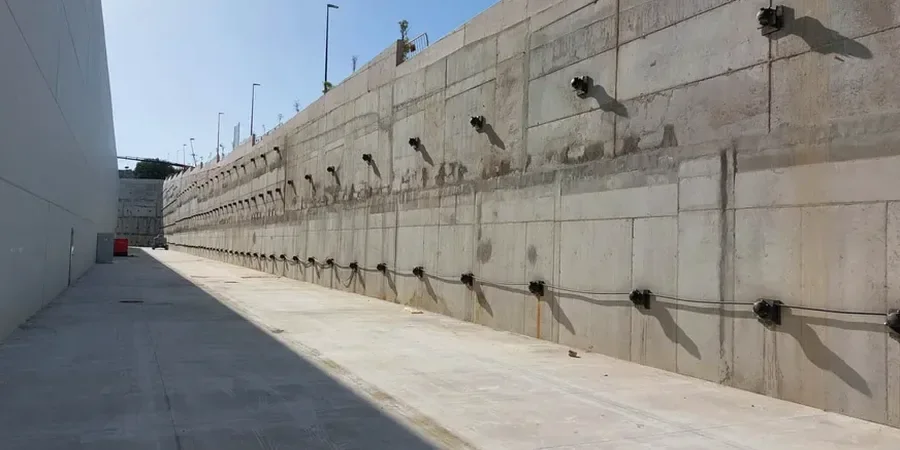
Typical technical challenges in Peoria Arizona
Our Peoria field crew typically mobilizes with a Klemm 806 drill rig mounted on a tracked carrier, which lets us set up on slopes up to 25 degrees without benching a flat pad first—a real advantage on the hillside lots north of Pinnacle Peak Road. The duplex drilling system handles the transition from soft sandy silt into hard caliche without switching tooling mid-hole, maintaining production rates of six to eight anchors per shift even when the bond zone extends into the cemented layer. We run hydraulic jacks with digital pressure transducers for the performance tests, capturing load-displacement curves that the project engineer can review before the next lift of excavation proceeds. When the design includes grouting verification, the same rig can switch to a sleeve-port system for compaction grouting beneath the anchor bond zone, addressing loose pockets that the initial borings may have missed.
Our services
Every anchor system we design in Peoria starts with a clear definition of the service life, corrosion environment, and load-transfer mechanism. The four core service packages below cover the range from temporary excavation support to permanent tiedown anchors for structures subject to uplift.
Active anchor design and load testing
Complete submittal package including bond length calculations, tendon selection per ASTM A416, stressing sequence, and on-site proof testing with calibrated hydraulic rams.
Passive soil nail and tieback systems
Design of fully grouted passive inclusions for slope stabilization and cut faces where deformation tolerance allows non-stressed reinforcement to mobilize gradually.
Corrosion protection engineering
Class I and Class II encapsulation details for permanent anchors in aggressive desert soils, including epoxy-coated bar, corrugated sheathing, and sacrificial anode specifications.
Anchor remediation and forensic evaluation
Lift-off testing of existing anchors, strand-by-strand inspection, and redesign of underperforming systems discovered during excavation monitoring or structural surveys.
Top questions
What is the typical cost range for anchor design and testing in Peoria?
For a standard project involving 10 to 30 active tieback anchors with proof testing, the engineering design, submittal preparation, and field load-test oversight typically range from $1,150 to $3,570 total. The final figure depends on the number of distinct anchor types, the corrosion protection class required, and whether the project needs performance tests with extended creep monitoring beyond the standard 10-minute hold.
How do you determine whether an active or passive system suits my Peoria site?
The decision hinges on allowable deformation. Active anchors are prestressed to lock off at 80-100% of the design load, which limits wall movement to fractions of an inch—critical when the excavation is adjacent to existing buildings or utilities along arterials like 83rd Avenue. Passive anchors develop resistance only as the soil mass deforms, making them more economical for temporary cut slopes and remote hillside cuts where a few inches of lateral movement are acceptable.
What testing confirms an anchor meets the design capacity?
We follow the PTI DC35.1 proof testing protocol: each production anchor is loaded to 133% of its design load in a single cycle, with load-hold readings taken at alignment load, 25%, 50%, 75%, 100%, and 133%. Creep must stabilize to less than 0.04 inches over a 10-minute hold at the maximum test load. For critical permanent anchors, we may also specify a performance test on a sacrificial anchor loaded to failure to validate the ultimate bond stress assumptions.
How long does the anchor installation process take on a typical Peoria commercial site?
A crew of three operating one drill rig can install and grout six to eight anchors per shift in favorable ground conditions. The grout requires a minimum three-day curing period before tensioning begins, so the full cycle from drilling to locked-off anchor runs about four to five working days per row. Larger projects with multiple rows are sequenced to allow concurrent drilling and tensioning operations on different levels.